



Every unit of stock in a retail supply chain gets touched twice: once by machines in the warehouse, and once by people at the store. Most handling equipment is designed for one of those environments and tolerated in the other. Pallets are built for forklifts, and become a burden the moment they reach a store door they can’t fit through, or they need a pallet jack to move in store environments.
The roll cage is the exception. A cage on wheels works at full speed in both worlds: moved in multiples by MHE in the DC, and pushed by a single person at the store. For UAE operations, that dual capability removes cost and friction at every handover point.
Roll Cages in the Warehouse: Long-Fork Power Pallet Trucks, Three Cages at a Time
Warehouse roll cages don’t slow down MHE – used correctly, they speed it up.
With long-fork power pallet trucks, operators can pick up three roll cages in a single movement. Sometimes the long forks don’t work due to space constraints of the warehouse, but standard to mid forks also handel between 1 and 2 cages depending on the design. That changes the tempo of core DC processes:
- Faster picking and marshalling. Instead of shuttling one pallet at a time, a single operator picks and repositions 3 store-ready cages per run, fewer trips across the floor, quicker order assembly.
- Faster loading. Three cages travel from the staging lane to the tail-lift together, so vehicles are loaded in fewer MHE cycles and outbound lanes clear sooner.
- Better MHE utilisation. The same fleet of power pallet trucks moves more volume per shift, deferring the need for additional machines and operators.
Because cages are loaded at store-order level in the DC, the unit that MHE moves in the warehouse is the same unit the store receives in most cases, depending on your constraints and picking setup – while there no re-palletising, no break-down and re-stack between environments, you do have the opportunity to consolidate cages in the marshalling lane which are not fully utilized.
At the Store: One Person, No Equipment
This is where the roll cage separates itself completely from the pallet.
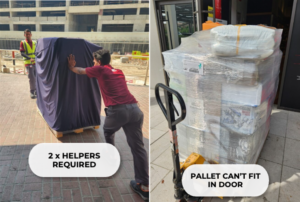
In GLS’s Dubai delivery trials across live DC-to-store routes, pallets required a pallet jack and dolly on the vehicle and two helpers per pallet to move stock. Many store doors couldn’t take a pallet at all, forcing double-handling at the kerb, and only one pallet could move inside a store at a time.
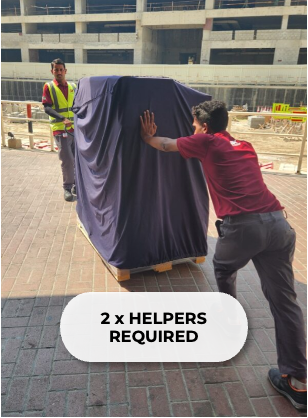
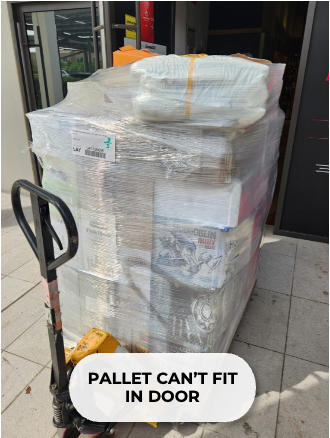
Retail roll cages needed one person per cage and no handling equipment whatsoever. The roll cage trolley rolls off the tail-lift, through the store door, and straight to the shelf edge. Results at like-for-like stores showed offloading times roughly 40% faster per unit of stock moved, with turnaround times cut by around 8 minutes per pallet-equivalent.
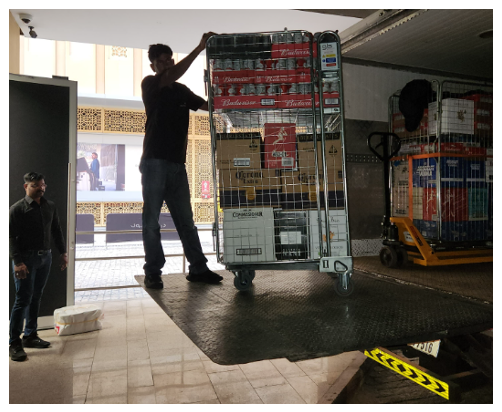
For store teams, this means replenishment happens from the cage itself, stock moves through the aisles on its own wheels, and the driver is back on the road while a pallet delivery would still be at the tailgate.
The Roll Cage Benefits Are in the Combination
The commercial value isn’t in either environment alone, it’s in the fact that one piece of equipment serves both without compromise:
- In the DC, MHE moves cages three at a time, so warehouse productivity holds or improves versus pallets.
- In transit, cages cube the vehicle better and need no jack or dolly on board.
- At the store, one person handles what previously took two people and two pieces of equipment.
- Across the chain, stock is touched less, damaged less (a measured 20% reduction in the Dubai trials), and moves faster at every node.
Fewer touches, fewer helpers, fewer machines at the delivery point, and no loss of speed where MHE does the heavy lifting.
Built for UAE Operations
GLS roll cages are specified for the way UAE supply chains actually run: castor options for different floor surfaces, nestable designs that collapse for empty return legs, and dimensions matched to common UAE vehicle specs. Our GCC Rollcage was designed in and for this market.
About GLS
GLS International is the Middle East’s largest roll cage supplier, backed by 30+ years of supply chain experience and over 100 million equipment movements annually. We support UAE retailers, FMCG distributors, and 3PLs with equipment, tracking via our G-Track platform, and managed solutions.
Want to see the handling difference on your own routes? Contact GLS at [email protected] or +971 56 609 0638 to arrange a demonstration.
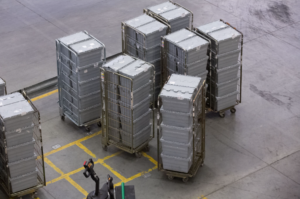
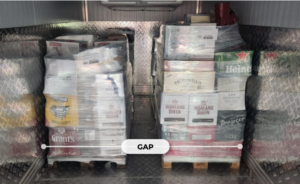
Truck Cubing in the UAE: Why Roll Cages Move More Stock Per Vehicle Than Pallets
The pallet’s disadvantage isn’t the pallet itself — it’s the space it wastes around it. In the Dubai trials, measured